Prince Ea speaks the truth.
NASA’s Mission to Mars and Lessons We Haven’t Learned
Today, NASA administrator Charles Bolden spoke to lawmakers about NASA’s ambition to send a manned mission to Mars. Its explicit goal is to study catastrophic changes to the red planet’s climate and geology: the loss of its magnetic field and a giant ocean. The hope is that a better understanding of these planetary shifts might help us better understand planetary changes on Earth. Bolden suggests that the ultimate goal would be to become “Earth-independent,” in case things go badly here. The elephant in the room is, of course, climate change. If (when?) we ruin our planet and need an escape pod, we hope that Mars will be able to provide safe haven. The ambitious mission is commendable, but it reminds me, as it has others, of the Space Race of the 1950s-1970s. No surprise, as the tensions of the Cold War are the basis of NASA’s more successful missions and, for a time, its enormous budget. Following the Russian successes of Sputnik in 1957 and Yuri Gagarin in 1961, President John F. Kennedy announced that Americans would land on the moon first.

One of the greatest photos ever taken.
On the morning that Apollo 11 settled down onto the lunar surface, an anonymous essay appeared in The New York Times, entitled “Ad Astra.” It applauded the great achievement of the moon landing, but also offered a more sober perspective that I’m reminded of now and again these days: with SpaceX’s wildly popular efforts to develop space flight as a private enterprise, Bolden’s mission to Mars, and ever-worsening news about drought, threatened crops, unseasonable snowstorms, and other realities of environmental disaster. The essay continues:
“And therein lies the irony inherent in this most extraordinary expression of man’s prowess. As man gains another world – with the prospect of adding another and still another, literally ad infinitum – he stands in imminent danger of losing his own. Transfixed by the glowing vision of the stars, he too easily turns from his ugly failures on this earth. He cannot afford to do so, least of all at this moment of his triumph in the skies [. . .] For all his resplendent glory as he steps forth on another planet, man is still a pathetic creature, able to master outer space and yet unable to control his inner self; able to create miracles of science and yet unable properly to house and clothe and feed all his fellow men; able to eventually colonize an alien and hostile environment and yet increasingly unable to come to terms with the nurturing environment that is his home. The great question for the decades to come is not how or why or when man will continue his excursions under the arch of heaven, as he certain will; but whether the magnificent accomplishment celebrated throughout the world today will at last inspire him to achieve the age-old goals of which he is capable and for whose realization he has yearned so long: life in harmony with nature, peace with his fellow man and a just society on this no longer lonely planet earth.”
This was written in 1969, probably by Paul Bigelow Sears, and it is a message that is just as fresh, urgent, and necessary today. As we look to Mars, we should also think about what we can do to save our home here on Earth. These efforts might not be as technologically spectacular, but they are necessary and will do as much if not far more for humankind in the end.
Let’s Take Health Research More Seriously
Jason Silverstein published a great article in The Atlantic today (read it here!). It asks an important question: why do we keep looking for a racial basis for health disparities in the U.S.? I posed this same question to students in my upper level “Culture of Health” course this semester and was surprised at the answer: because, of course, our health is genetic and we share genetic patterns with people of the same race, so race is a good way to study our vulnerabilities. The universal acceptance of this logic among the Communication, Sociology, and Public Health students in the class surprised me because these young men and women have chosen to major in disciplines that define themselves by taking social behaviors and cultural values seriously. Yet they immediately threw aside all social and cultural explanations for the biological.

And they are young. Shouldn’t they know that it is almost universally agreed amongst scientists and social scientists why study such things that race is not a biological construct? Silverstein quotes scientists in Nature Biotechnology who wrote about this in 2005 (“Pooling people in race silos is akin to zoologists grouping raccoons, tigers, and okapis on the basis that they are all stripey.”). Dorothy E. Roberts has also written about this problem. We continue to practice, and to invest in, race-based medicine when we know that racial categories aren’t scientific categories; they’re social. Silverstein’s suggests that this persistent misfiring occurs due to the political ramifications. We don’t want to think about the need to reorganize our society, to really address inequality; we’d rather look (hard, and very expensively) for keys in our genetic code. Silverstein is correct, and this observation also happens to fall rather neatly across the lines of U.S. political categories. But I think the problem is deeper than that. Why else would my students, who have earnestly studied social inequality for years in their respective disciplines, immediately resort to biological explanations which they know relatively little about?
1) Our belief that race is a real, meaningful way of understanding individuals is incredibly tightly held. It’s ideological, interwoven with US history (medical, social, scientific), and very difficult to dislodge even in our own thinking. We too often never even think about how nonsensical American racial categories – and the assumptions we have about people based on them – look to people in other countries. It’s a truth we hold to be self-evident.

2) We have a real fetish for biology these days. The success of companies like 23andMe alone attests to the desire we have to know ourselves genetically. This is not to say that biological research isn’t important for addressing health inequality or for understanding ourselves; often it is. But for most of us, our genetic codes are not the map of ourselves and our futures in the way that we think. Biologists know that even if you look at the purely physical development of an organism from a genetic standpoint, you have to accommodate a large amount of environmental factors – and chance – into your model in order to arrive at an accurate, modern understanding. And that’s even before we get to the old nature/nurture debate. And the sphere of popular culture and internet misinformation, we also try to explain an incredible array of things that are not primarily biological with genetics. (Do you dislike strawberries? Do you find a certain kind of visual pattern off-putting? Perhaps it’s in your genes!)
3) We want technology to solve our problems. Taking structural inequality and prejudice seriously is incredibly difficult and tedious; scholarly, political, and bureaucratic even. But we love technology. We desire it. We imagine technological solutions to be painless, delightful, and incisive (even though they take an enormous amount of work, capital, and risk to produce). And they often miss the mark, sometimes in small ways, other times insidious, irrevocable ones. So here’s my proposal: that a lot of time THE TECHNOLOGICAL SOLUTION IS INEFFICIENT. Such solutions take a lot of time and money and often don’t get the job done. In the case of the mistaken notion that racial health inequalities can be addressed through biological means, it’s detrimental. Health and medical research that uses racial categories for biological study re-encodes race as a biological construct, keeping us even more falsely divided.

4) We need to educate our young better. Silverstein’s article is an important piece of writing and I applaud him; but nothing in it is new. Yet none of this research was familiar to any of my young students, whose areas of study hover in precisely these areas. Biologists, social scientists, and humanities scholars alike know that race is not biological, but social. In a society where STEM is so highly valued, it is natural and not surprising that we favor biological and engineering perspectives and solutions. This needs to be better balanced (integrated!) with social science and humanities perspectives. Students need to understand how the concept of race as a biological construct appeared in our society historically, how the rhetoric has been produced and reinforced, how it has been re-encoded into scientific research too often. Otherwise, we waste our resources (a tremendous amount of money in health and medical research to say the least) chasing something that could be addressed another way more effectively.
I personally spent years training and working in a lab to try to understand how to reduce the devastating impact of HIV/AIDS on the population. I still think this is a worthy effort and my heart is gladdened by successes in the field. But over a decade ago I came to believe that solutions that address the social and cultural underpinnings of the spread of this disease were completely undervalued as decades of expensive biological research went on. I hope to see us tackle the difficult task of integrating knowledge across disciplines better so that we can address health issues more effectively.
Beyond Human Futures
Recently, I was on a conference panel organized around technology, affect, and bodies that reach beyond the human. My fellow presenter, Marina Levina, in a presentation about the biopolitics of synthetic biology, flashed up a picture of Freckles the Spider-Goat. We oohed and aahed as we pondered the ontological. How do we relate to this created being? What are the ethics that govern our relationship to her and how do we arrive at them? Or, as Marina so wonderfully quipped, “She’s here; she’s queer; how do we get used to her?” The broader panel-wide conversation moved on to argue for embracing the multiplicities, possibilities, and contradictions when trying to understand new, technologically produced forms of being. In the context to my last post, that might have fallen into the category of thinking about H+ futures as inherently affective – perhaps painful, angry, or loving – and therefore deeply human, rather than reductively cybernetic. I think it might be said that we were trying to theorize a pluripotent future.

Freckles the Spider Goat, photo from the Guardian
Today, I came across a post about extinction that stopped me cold. A conservancy in Kenya called Ol Pejeta is trying to keep 23 white rhinos and 105 black rhinos alive on 9,000 acres of protected land. A team of well-trained rangers armed with night vision goggles, weapons, and tracking equipment protect the animals from poachers. The last male northern white rhino on earth is guarded 24/7 as it lives out its remaining days. His name is Sudan. What does Sudan have to with Freckles? Maybe nothing. But it occurs to me that we while are so busily building theoretical structures to support the biopolitical future of H+ humans and animals produced from synthetic biology – a future that we feel is arriving with such urgency – that we’ve forgotten the present and what otherwise might be. We forgot about Sudan. And human and animal (and climate) futures are so thoroughly intertwined, we know. Indeed they should be considered inseparable.

White rhino protected by rangers, via @olpejeta. More here http://www.gofundme.com/olpejeta
So my question: is there a framework that comprehends both the reality of mass animal extinction and the potential of the posthuman? It seems to me that so many visions of the posthuman deal only with the human, that the living world of animals and the environment is almost always extinct in those futures. Take for example Margaret Atwood’s Oryx and Crake, a dystopian novel that, for many, captures the world of synthetic biology exceptionally well. This world is filled with strange, wondrous, monstrous synthetic animals rather like Freckles the spider-goat. Pigoons are overloaded with human organs for harvesting; Chickie-Nobs are transgenic sources of poultry meat. Animals populate this biofuture but they are creatures whose existence is defined almost entirely the needs and logics of that posthuman future: science, medicine, capitalism, industrial food production, etc. Happily, at the end of the novel, they wander free across an apocalyptic landscape, living robustly on. I doubt the same can be said for Sudan. I don’t mean to reinforce the nature/culture divide here nor do I think that a redeployment of cyborgian hybridity is quite appropriate. What to make of this?
Some Thoughts on Scrapheap Transhumanism, the Purpose of Pain, and the Limits of Human Experience
“What kind of moron would want to feel EM waves? A sensory overload = PAIN [. . .] BRILLIANT!! Good job, freaks.” – wtf?
This was the top comment offered in response to a 2012 Wired article on the then-new phenomenon of DIY biohacking. DIY biohacking or scrapheap transhumanism involves the practice of implanting small electronic sensors under the skin, often through self-surgery, to explore transhumanist potential: the ability to sense electromagnetic fields, for instance. Its political commitments align with citizen science, open source, hacker, and maker movements. For vanguardist biohacker Lepht Anonym, who is the focus of today’s talk, the icons of the DIY biohacker laboratory are vegetable peelers, vodka, inexpensive commercially available sensors, Sugru self-setting rubber, and the like.
In this post, I explore certain schisms within the transhumanist community as a way of investigating the vital significance of pain as a gateway in the representation of radical embodiment that also disrupts boundaries between subjects, human and machine cognition, knowledge and feeling, researcher and research subject, and interior and exterior as separated by the barrier of the skin.
A Tension in the Transhumanist Community:
Charles T. Rubin, a writer for the tech web journal The New Atlantis, captures well the criticism and skepticism leveled at scrapheap transhumanists, and specifically Lepht Anonym. He states that Lepht Anonym’s biohacks are self-mutilation and a “cry for help”: “When young people cut themselves [. . .] as so many today, especially young women, do – it is still relatively obvious even in our tolerant times that they are in need of psychological assistance.” This paternalistic and gendering take on biohacking performs a sharp, double dismissal of Lepht Anonym’s work: first, as failing to fully grasp or attempt the serious project of transhumanism; and second, as juvenile and feminine preoccupation. Rubin is definitely not the only transhumanist to characterize Lepht Anonym’s work in this way.
Within the biohacker community, Tim Cannon, founder of a Pittsburg based DIY biohack group Grindhouse Wetware, criticizes Lepht’s self-work in a surprisingly similar way. He calls her a “pioneer and innovator” in a Wired Magazine feature, but he too suggests that Lepht’s work fails to take seriously the project of transhumanism. He cites his own group’s work as professionalizing and “bringing the scientific method into” biohacking. On reddit, other grinders suggest that Lepht’s work fails to meet the standards of legitimacy that Cannon wants to leverage for the biohack community because it lacks “rational experimentation.” One redditor called pyx posts, “I worry that she did it more out of anger than out of rational experimentation. On the other hand, a lot of our best discoveries came about that way.” At the same time, Cannon suggests that Lepht is not someone society would “want to get tax advice from,” and contrasts the counter-cultural approach to his own role as father: “I come up with my two kids and a career that pays well, they think maybe rational minded stable human beings are involved in this, not just punk rockers who cut themselves.” This rhetoric is surprising not only because it so closely mirrors the rhetoric of those who would dismiss biohacking outright. In fact, both Rubin and Cannon dismiss Anonym and establish their own legitimacy with almost fatherly language that casts Anonym in the role of the wayward daughter. This is also surprising because Cannon’s own self-experimentation in practice looks quite similar to Anonym’s: neodymium implants in the fingertips for sensing magnetic fields, or the subdermal implantation of simple hardware devices that communicate with external hardware like a computers (a device called Circadia that reads and transmits bodily data via Bluetooth in the case of Grindhouse, or temperature and RFID devices in the case of Lepht).
I suggest that there is an attempt to exorcise the unruliness of Lepht Anonym’s work and body from the field of transhumanism. Cannon, Rubin, and pyx of reddit are just a few representative voices. Individually, they have very different political commitments with regards to transhumanism but they come together in their criticism that Lepht Anonym’s body of work is chaotic, female, dangerous, and physically and psychologically ill. This in contradistinction to their own domains of work, which align with scientific reason, rational experimentation, and professional or semi-professional expertise. I will now go on to consider that unruly body. For as Tim Cannon himself acknowledges, Lepht Anonym is not only a “freak,” she is also a pioneer of the field – one in whose footsteps everyone else is following, albeit with disavowal. I will do so by talking first about physical pain.
Pain & Skin:
Pain is a curiously insistent feature of grinding for Lepht Anonym. On the one hand, it is a practical concern in the practice of self-surgery. As Anonym mentions at the 27th Chaos Communication Conference in 2010, where they were invited to speak as the representative of biohacking, anaesthetic is of course unavailable to the general population in many countries. Self-surgery circumvents legal and ethical issues about medical experimentation on others in most places but it is also tricky, painful, and bloody. You need a spotter, Anonym emphasizes, because you will pass out. Neodynium magnets, used to give the hacker passive, sensory awareness of electromagnetic fields in their environment, are implanted into the fleshy pads of the fingertips, one of the most sensitive areas of the body. Anonym has almost a full set, each self-implanted with a large needle or a certain type of vegetable peeler using techniques perfected over time. The Grindhouse Wetware hackers hire a professional piercer to perform this task (which is illegal, according to Anonym, in most European countries).
Yet pain seems to be an important feature of grinding for Anonym, one that cannot simply be dismissed with the availability of anaesthetic. Here I’ll mention two things. First, Anonym is completely uninterested in external haptic sensors – wearable devices like one called Northpaw that can provide the wearer with the same information as implanted sensors, but don’t need to be painfully embedded into the flesh of the body itself. Second, they readily admit, in marked contrast to other transhumanists including other grinders, that these hacks serve no greater purpose other than to exercise curiosity, for play, and perhaps to provide an extra layer of “data” about the environment. One may be able to feel the shape and force of a magnetic field or identify oneself to a computer with RFID, but neither sense provides functional advantages over existing, non-embedded technologies. What then, is the “purpose” of all this pain, critics wonder? Both points, I suggest, mark a divergence in the way that Lepht Anonym conceptualizes what it means to be a sentient, experimenting subject, from how others in the community define transhumanism.
Elaine Scarry writes about physical pain and the boundary of the body, or skin, in a way that may be helpful here. Scarry suggests that physical pain can be used to theorize the limit of human experience. She begins by asserting that the inexpressibility of pain defines the interiority of the subject and is without external referent or object: it isolates; it demands nothing except for its own subsidence; in defining this interiority it stops at the skin. This is counter-posed to imagination, which sends the subject outside of itself into a world of referents. The loop between “pain” and “imagining” constitutes the “framing events” or boundary conditions of the human psyche. Together, with one satisfying the other, pain can be transformed from a passive and isolating occurrence into a self-modifying one. The best name for this transformative possibility, Scarry writes, is “work”:
Work and its “work” (or work and its object, its artifact) are the names that are given to the phenomena of pain and the imagination as they begin to move from being a self-contained loop within the body to becoming the equivalent loop now projected into the external world. It is through this movement out into the world that the extreme privacy of the occurrence (both pain and imagining are invisible to anyone outside the boundaries of the person’s body) begins to be sharable, that sentience becomes social and thus acquires its distinctly human form. Scarry, Elaine (1985-09-26). The Body in Pain: The Making and Unmaking of the World (p. 170). Oxford University Press. Kindle Edition.
Scarry’s reference to sentience in relation to physical pain is significant. Through work, pain and imagination become a sentience that is meaningful, communicative, and human. Furthermore, work becomes an act of creation, of making. We see this in the creation and use of technology, from eyeglasses and telescopes as enhancements to sight or computers as devices of self-replication and self-modification. With technology we project ourselves into the world, “turning the body inside out,” Scarry asserts. Technology does more than project our interior states onto the external world. It also brings the outside in. Thus, work, or technology, in some sense takes the inanimate world into the sentient interior even as it exerts our painful interiorities onto the inanimate external environment. If we approach the world as fundamentally animate and alive, technology does our work even as it also works on us. Scarry borders on theorizing both distributed cognition and intersubjectivity where she pushes the transformative work of pain to its boundary limits.
Lepht Anonym’s work, I am suggesting, clearly recognizes this transformative relationship between physical pain, technology, human experience, and the turning of the skin inside out. The intimate necessity of pain to generating a technologized self-making that is functionless, yet nonetheless transformative and important, seems to be rooted in a notion of meaningful sentience as defined by this turning of the body inside-out. It encodes a belief in the aliveness – animateness? – of both oneself and the outside world. Anonym’s version of biohacking is sensory, local, embodied. Subdermal sensory abilities are sent out into the environment while also drawing that environment (EM fields) back under the skin. The purpose of the pain of self-work may be thus understood to be an affective, embodied theory of cognition. This is also, I suggest, why painless external, haptic sensors are useless to Anonym.
Another way to approach this is by taking a brief look at another thread of transhumanism.
Cybernetic Transhumanism:
If DIY biohacking, or grinding, is a countercultural movement, then cybernetic transhumanism is the mainstream. A quick look at Singularity University in Silicon Valley, which describes itself as “solving humanity’s grand challenges,” captures the distance between these two approaches to the posthuman. Whereas the ethics and politics of DIY biohackers champion citizen science, open source, access and experimentation for public use and public good, Singularity University is endowed by billion-dollar Silicon Valley corporate founders including Autodesk, Cisco, and Genentech, and tech luminaries like Ray Kurzweil and Peter Thiel (founder of PayPal). It is essentially an elite, moneyed, private laboratory that makes claims to guide evolution through technological innovation, the end goal being artificial intelligence and immortality. By contrast, the aims of DIY biohacking as embodied by Lepht Anonym are radically local, embodied, and non-teleological.
The logic of the singularity hinges on artificial intelligence in a way that I think is instructive. It follows in the line of cybernetics after the postwar Macy Conferences, which Elizabeth O. Wilson argues marks a moment of divergence, when intelligence began to be seen in ways that are now familiar: disembodied, rational, and defined by the exile of the domains of affect or emotion. For a popular cultural referent, we might look to “Data” the Star Trek character. The moment of definition came with the McCulloch-Pitts neural network, which posit that the brain’s neurons can be modeled as binary, or digital; thus intelligence becomes computational, opening the way for artificial intelligence. Ray Kurzweil, futurist and founder of the notion of singularity, builds on this idea with the transhumanist proposition that AI can overcome problem of the frailty of the human body; the body can be done away with. Kurzweil has designed a number of very powerful and highly successful technologies, including optical character recognition, text to speech synthesis, speech recognition, etc. all of which replace bodily functions with digital capabilities that could serve a cybernetic brain. This theory of cognition is, it seems to me, reductive, isolating, and somehow inanimate; its telos is the automaton. More to the point, this vision of the posthuman as a computational brain served by ancillary digital sensors is radically different from Lepht Anonym’s painful and fleshly embodied cognition.
Elizabeth A. Wilson, drawing from a close analysis of Alan Turing’s founding work on cognition and computing, asserts that affect is not at all separate from intelligence. Rather, these two domains that we now hold separate have also been posited as dependent, intimate, and reinforcing. Turing’s response to the question “can machines think?” is “I shall never know, any more than I shall ever know that you feel as I do.” Wilson reads this as a playful challenge: the point is not so much whether machines can think versus feel but rather that the question itself poses the problem of the epistemology of the interior. Intelligence, Wilson argues, is intersubjective, a commerce in ideas and affect, wherein affects motivate and amplify ideas and cognitive processing transforms information. Wilson’s concept of affect-integrated artificial intelligence looks very much like Scarry’s notion of sentience born out of physical pain and experience. Wilson writes, “the mind is not confined to the brain, the skull, or even the boundaries of the biological body: it takes up tools and technologies out in the world in order to expand cognitive space. The annexation of technological objects are the very stuff of human cognitive processing,” and the introjecting mind also brings the world inside. This is in contrast to disembodied, computational intelligence as the vehicle of posthuman futures that is captured by the singularity.
For Lepht Anonym, I suggest, grinding draws its significance in part from the precisely painful self-practice of implanting subdermal sensors. They don’t promise eternal youth or immortality, but rather the ability to access cognitive experience, to play with, invert, this relationship between technology and interiority by painfully puncturing the skin. External haptic sensors are ancillary; they might be understood in this context to serve disembodied cognition in ways that reinforce the distinction between inside and outside, intelligence and the exterior world it acts upon, the animate human brain and the inanimate environment.
Finally, I suggest that for Anonym pain transforms the posthuman into something not less human, but more human, because it is embodied. Both Anonym and Turing understand this, and thus both highlight the vital necessity of an “ongoing curiosity [. . .] for the embodied, for the childish, and for feeling” (Wilson 6) in their work.
Musings: Etienne-Jules Marey and the Pre-History of Tracking
In the Bay Area techtopia, the quantified self / self-tracking trend is fresh and compelling: social media, wearables, handheld devices, and apps make information visible with a stunning level of detail across time. We can see our bodies and our behaviors; we can track how we spend our time it. It seems undeniable that our lives are moving into levels of abstraction that are increasingly fine and deep. Today I’m thinking about that move towards the abstraction and instrumentalization of the human body, and my past work on similar themes in a different context. Can the self-tracking movement that is flourishing be connected to the history and work of 19th century chronophotographer and physiologist, Etienne-Jules Marey?
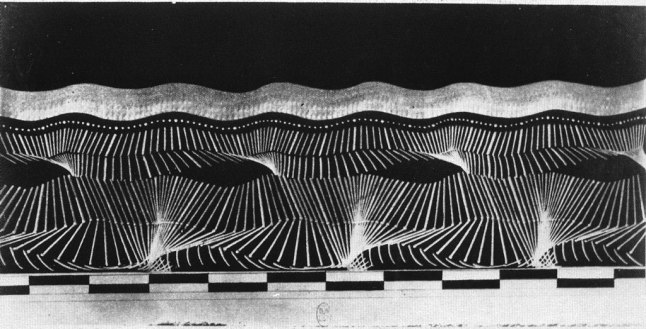
Etienne Jules Marey’s “Joinville soldier Walking,” 1883
Etienne-Jules Marey, whose work in physiology spanned the 1860s-1890s, translated the living body into metrical traces – angles, flows, durations, volumes, intervals – that could be visualized and analyzed in the interest of producing better efficiencies in human movement. His insight – that all different levels of movement in the human body from the beating of the pulse at the wrist to running and jumping could be produced as metrical abstraction – was assuredly an informational perspective that anticipated developments over the next century. He pursued this vision at every scale. His work broke the body down visually and objectified it into slices of abstraction that could be analyzed to develop a mathematical understanding of human movement, and human life more generally. This view of life anticipated major medical advancements like blood transfusion and organ transplantation.
Marey’s work in abstraction was metaphorical up to a point. His research transformed the way we understood our bodies; he was participating in a general trend of the period that re-imagined life, human and otherwise, as a closed world of energy that had to be harnessed and put to work – (pre)Taylorist dreams backed by the science of the time. Since he was working in the wake of France’s defeat in the Franco-Prussian War, Marey was largely interested in questions of fatigue, efficiency, and energy in the human body. These preoccupations are perhaps not so different from what motivates many self-trackers today. Self-trackers measure their own breathing patterns, heart rates, and the number of steps they’ve taken in a day – often, in order to render them into graphical form. They look for trends and use that information to make improvements.
Of course, Marey was tracking a generalized idea of the human form. He used soldiers as models for his studies in human movement. He was also interested in animal locomotion and movement more general – air streams, water, he wanted to track it all. To pin down curvatures, speed, flow – to graph that movement. To enter into that type of research with the self as object is another thing again, perhaps. It is highly individualized, personal, not to mention it turns the object into agent. According to Dawn Nafus it is also highly idiosyncratic, and following along in that vein, the (bio)politics of self-tracking are distinct as well.
I don’t doubt that there is a resonance here, though. Deborah Lupton has also linked the history of what she calls “visualizing and monitoring practices in medicine,” or a mechanical view of life, towards trends in digital innovations that increasingly promote patient self-surviellance and self-care (her blog posts on QS on that and more can be found here). I’m interested in the ways those resonances between Marey’s work, and other work that emerged from the notion of technology as an interface between the human body and a drive for efficiency, open up questions about what self-tracking is, how its history is told, what its implications are.
This was a quick one, so just for fun, here’s a picture of Lillian Gilbreth’s turn-of-the-century time-motion study of a golfer’s swing:

Lillian Gilbreth’s chronocyclograph of a golf swing, 1915
And an iPhone screenshot of the Zepp Golf app in the iPhone 5S ad:

Which one looks like the better golfer?
Go You Chicken Fat Go
Apple’s newest iPhone commercial splashed down last month and sent up a flutter of confusion. Folks reported being puzzled and distracted by the song that backed the visuals of young people running up hills, swimming laps, doing push-ups, and generally getting their sweat on. As has been well reported, the song was commissioned by the 1962 President’s Council for Physical Fitness to encourage thousands of schoolchildren to put in a little more effort in gym class. Nostalgia, and surprise at unsubtle lyrics, seem to be the prevalent reactions to this ad. But what was the point? What is the commercial – which apparently, being distracted by the song, no one really watched – about? The iPhone (and now Apple) are really all about Data and Health.
The commercial, and the song, herald Apple as a contender in the health-targeting wearables market. The newest iPhone isn’t about its music player, video quality, phone camera, or the like. It’s about fitness and health. It’s making a play to be the device of choice for quantifying and tracking exercise by seamlessly integrating with wearables that you are already using, or will be using, to measure the data it produces from your activities all day long. This is the iPhone as a self-tracking device.
Things tracked (an incomplete list):
- Woman swimming in lap pool puts small NFC(?) device on her phone (Misfit Shine?)
- Man steps onto scale in his bathroom. Tracking his weight loss on his phone (displayed with a beautiful graph).
- Young gymnast watches a playback video of her backflip.
- Golfer tees off a long drive. Speed of golf swing.
- Man does pushups at the beach. Progress through workout.
- Another man, similar to above, but with bench press.
- Another woman, similar to above, but with mountain climbers.
- Some kind of soccer field workout.
- Distance run (woman who we saw at the beginning running up a hillside) we and she finally get to see her numbers show up.
- Trajectory / curve of soccer ball kicked toward goal.
- Numbers on a bike (iPhone on handlebars).
- Running along the pier at the beach.
In the ad, we see a number of devices that integrate seamlessly with the phone’s connectivity capabilities and beautiful display. Devices that measure heart rate, steps walked, calories burned – the data of the body – and devices that measure golf swings, pushups, mountain climbers – behavioral data – are logged, displayed, and presumably archived by your iPhone. In this, Apple marches in lock-step with the more general Silicon Valley trend in promoting a culture of self-tracking as self-knowledge. It’s also very much resonant with the moves other tech giants are now making (data + health): Google’s investment in Calico (California Life Company) as, essentially, a talent merge with biotech giant Genentech, for one.
Self-tracking has become the key to progress, health, happiness. Apple seems to recognize this and positions iPhone as the digital gateway to our ethical obligation for self-care. Data makes us “more powerful than [we] think” (to quote the Apple tagline for its new phone).
Does it? When, and how?
Other related thoughts:
I went to a QS Meetup in San Francisco last night that was chock full of new devices, practitioners of self-tracking and self-quantification, and people dedicated to a culture of data. I have lots of thoughts regarding the importance of feedback, open source, conceptions of the body & health, ethics of self-care, the relationship between personal tracking and big data, and the narratives that encode and enshrine all of this. Also, what self-trackers really like to track. Upcoming.

